One Room Is Enough
You don’t need to declutter your whole house this weekend. You don’t need a system, a label maker, or a free Saturday. You need one room.
One room, done properly, changes how you wake up. It changes how you unwind after a long day. It changes how the whole house feels, even the parts you haven’t touched yet. That’s how momentum works – it starts small, and it starts specific.
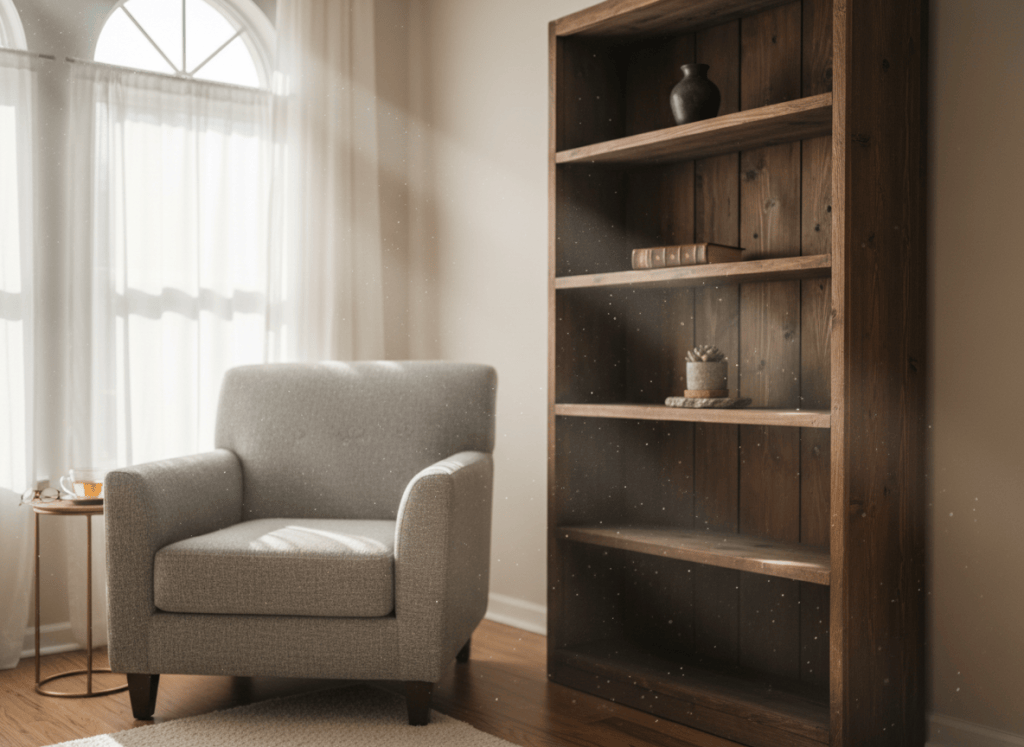
This isn’t about minimalism as an aesthetic. It’s about something simpler: a space that works the way you need it to, holding only what earns its place. Clarity in the room tends to produce clarity in the head. That’s reason enough to start.
I’ll admit where this started: Marie Kondo. I watched her Netflix series, then read the book, and her “spark joy” idea never quite landed for me – it always felt a bit much. But somewhere underneath the theory were a handful of habits that did stick. They changed my drawers, then my rooms, then, in a quieter way, my life at home.
Here’s how to do one room properly, in seven steps.
Step 1: Decide what the room is for
Before you touch anything, answer one question: what is this room supposed to do for you?
Not “what should it look like” but what should it do. Is it where you think clearly? Where you switch off? Where you get dressed and out the door without friction? A room without a job accumulates whatever gets put down in it. A room with a job starts sorting itself, because you’ll instantly know what doesn’t belong.
You’re not getting rid of things yet. You’re setting the standard everything else gets measured against.
Step 2: Clear the obvious stuff first
Walk the room and pull out anything that plainly belongs somewhere else – mugs, mail, chargers, tools, gear that comes from another part of the house. Don’t decide anything yet. Just relocate it.
This isn’t the real work, but it’s a fast, visible win, and it clears the noise so you can actually see what you’re dealing with. A cluttered room is often just a poorly sorted one – do this step and you’ll already feel the room loosen up.
Step 3: Work one surface at a time, start to finish
Don’t drift around the room touching a bit of everything. Pick one zone – the desk, the shelf, the drawer, the closet and finish it completely before moving to the next.
This matters more than it sounds like it should. Half-finished zones everywhere feels like more work than one zone fully done. Competence is built in complete actions, not scattered effort. Pick a target, take it all the way, move on.

Step 4: Ask sharper questions than “keep or throw away”
“Should I get rid of this?” is a weak question – it’s too easy to talk yourself out of an honest answer. Use better ones:
- Have I actually used this in the last year?
- Would I buy it again today, at full price, knowing what I know now?
- Does having this make the room better, or just fuller?
- Is this doing a job, or just occupying space?
Objects that fail these questions aren’t being punished. They’re just not earning their keep. That’s not sentimental – it’s just accurate.
Step 5: Sort into four piles, no fifth option
Keep. Donate. Sell. Dispose. That’s it.
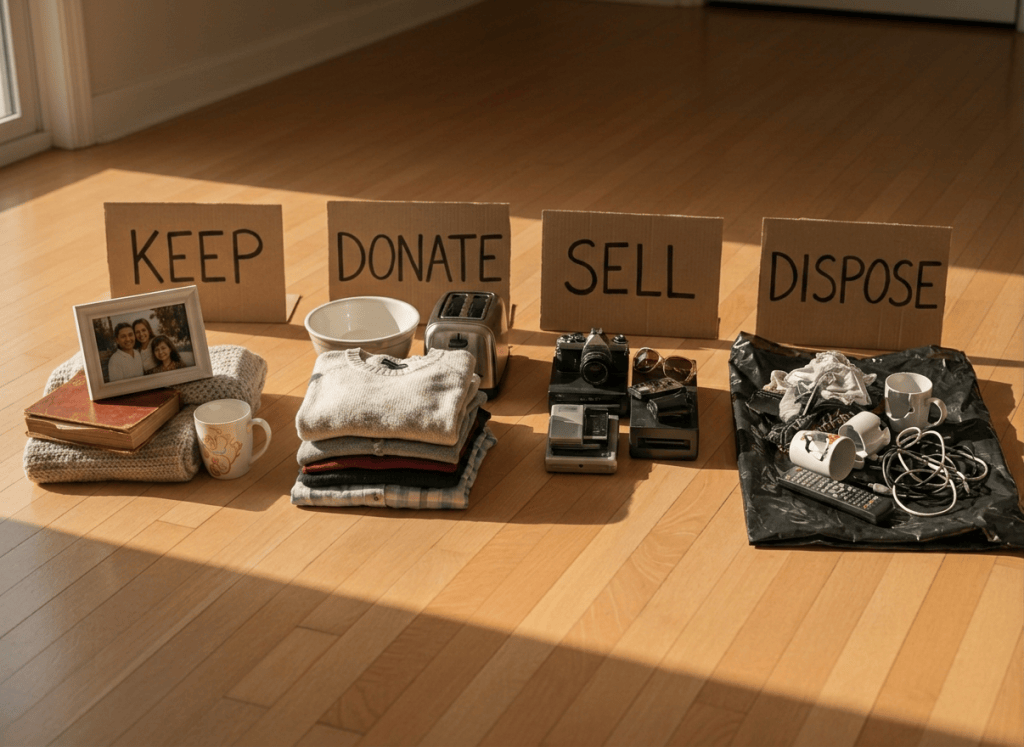
Skip the “maybe” pile. A maybe pile is just a decision you’ve postponed, and postponed decisions have a way of turning into the exact clutter you’re trying to remove. If something’s genuinely a throw away, give yourself ten seconds and pick. You’ll be right often enough, and wrong rarely enough, that it doesn’t matter.
Step 6: Don’t refill every space you just cleared
The instinct after clearing a shelf is to put something back on it. Resist that. Empty space isn’t a gap that needs filling – it’s part of what makes the room work. A shelf with breathing room reads as intentional. A shelf packed edge to edge, even if it’s all “good” stuff, just looks like the last room in a different form.
Leave some space empty on purpose. That’s the whole point of doing this.
Step 7: Finish it — actually finish it
This is where most decluttering efforts quietly fail. The piles get made, and then they sit. Donations wait by the door for three weeks. “Sell” items never get listed. The room looks better, technically, but the job isn’t done.
Take the donations to the car today. List the sell pile this week, or skip it and donate it too. Take the rubbish out now. A job that’s 90% finished still has all the clutter of a job that’s 10% finished — it’s just relocated to your hallway.
Before you move to the next room
Give the finished room a proper close-out. Vacuum. Dust. Open a window. Let it actually be done before your attention moves on.
Then use it. Sit in the chair. Work at the desk. Notice that it’s lighter, easier, quieter than before. That’s the payoff, and it’s worth pausing for before you think about tackling anywhere else.

The point of all this
Decluttering isn’t about building a perfect house. Most houses never get there, and that was never really the goal. It’s about making one part of your daily life a little more your own … a room that reflects what you actually value instead of what’s simply accumulated over time.
One clear room won’t fix everything. But every time you walk into it, it’s a small, reliable reminder that clarity is something you can build, on purpose, one decision at a time.
 Unrushing
Leave a comment